Showing posts with label #brazil. Show all posts

Wednesday, 16 July 2014

Brazil v Colombia, a big night out in Lencois

We left Salvador and headed inland to Lencois on a high after our last World Cup match USA vs Salvador, one of the best matches I've been at. 

I have detailed the Parque National Diamantina HERE but Lencois itself is worth a mention. A seemingly quiet town it is very much on the tourist trail and has a number of hotels, hostels and camoing to suit all budgets and travel styles. The number of tourist doesn't detract from the steep, narrow cobbled streets where restaurants spill out into the street at night. 

The covered market and several squares each form part of the local community social activity with people gathering to meet or passing the time of day. Many of the tour agencies and other businesses only open in the evening once the tourists arrive back from their treks and tours of the park giving the place a pleasant natural feel during the day.

Having witnessed most of the World Cup in the host city Salvador it was great to get a different experience watching Brazil v Colombia quarter final here. TV's were set up outside and together with Flyn, Rachael and Justin from our hostel we found a bar with seats out in one of the main squares next to the covered market, a perfect spot.

The town started filling with yellow as kick off approached with both visitors and locals sporting the Brazil colours.  As the players were warming up the local drum band marched out of the covered marked and gave a full blooded display getting the crowd worked up.

The game itself was tense with nerves all round. An early goal from Thiago Silva sent fire crackers screaming through the town, fireworks bursting from the hillside and significant beer spillage. Colombia had earned a reputation as one of the flair sides of the tournament and even though they looked nervous Brazil knew the danger was still there. A second goal mid way through the second half for a 2-0 lead was enough for another round of firecrackers, fireworks and beer spillage.  A late James (Ham-ez) Rodriguez goal was enough to quieten the crowd and only as full time ticked over did chants of BRAZIL BRAZIL BRAZIL echo through the square, on full time queue more firecrackers, more fireworks, more beer spillage and a return of the drum band on even more full blooded form than before. There was definitely a feeling of relief as much as joy as they had known Colombia were a form team.  

Dancing erupted in the street and the band, pied piper like headed off into the town, returning some minutes later with more people in tow. They took up position and the whole town, and bemused tourists burst into dance, led by one of the band leaders in what looked like a bizarre group aerobics workout.

Later in the covered market a fantastic Capoeira display broke out with the local club ranging from small children to honed experts facing off raising excitement levels further. Capoeira is a dance mixed with martial art with moves involving high kicks and somersaults. It is a staple of the province of Bahia, though I felt this was more genuine than the made for tourist displays in Salvador.


The town was clearly in the mood to party. Open backed Utes drove past with people dancing and playing Saxaphone in the back, youths honked their horns and a good time was had by all.

It was a pleasure to be in such an amzing country for the World Cup and sharing this night with Lencois was one of the craziest nights of all.


Friday, 11 July 2014

Tour of Lencois and Parque National da Chapada Diamantina

A seven hour bus journey inland from Salvador brings you to Lencois a historic diamond mining town which is the gateway to Parque Nacional da Chapada Diamantina. This enormous park is popular for hiking with many single or multi day options available.  Arriving in Lencois a stream runs along the road which crosses an arched stone bridge into one of the towns plazzas which houses a beautiful old covered market.


It is somewhat typical that having encountered unseasonably wet weather through most of our time in Brazil we arrived in a town known for streams, waterfalls and deep swimming holes at a time when the dry interior lived up to its name.  There are several walks to swimming holes which are easily accessible within an hours walk from the town.  The Serrano swimming holes are an easy walk, popular with locals and are literally deep holes in the rock river bed. Overlooking the town and surrounding woodland they are a beautiful spot to stop for a picnic and to relax. Most of the pools were dry and those that were full were crowded so we carried on up the path to a small waterfalls and stunning views just above it.

The second day the trip we'd booked to Cachoeira da Fumaca, Brazil's highest waterfall was cancelled so we headed out on a trip taking in caves, swimming holes (notice a theme developing?) and finishing at Morro do Pai Inacio, a peak affording incredible views over rocky plateaus stretching across the valley.

The first stop was the waterfall Poco do Diablo and for us the first realisation how touristy the area is, it was clear we were going to share the day with a crowd. Having said that, a pleasant walk from the car park along the stream, past interesting rock formations, it certainly felt relaxing after Salvador.  At the bottom of the fall a large deep pool formed which was perfect for a swim and a cool down.


The next spot was Lapa Doce, the sweet cave, one of many limestone caves which extend up to 29 kilometres below the park. Decending down from the dry plateau to the cool sinkhole which forms the cave's, er, cavernous 72 feet high entra.
Entrance to Gruta Lapa Doce, and below from inside


Visitors are able to walk approximately a killometre through the cave which is 60 metres wide in its central hallway and with good torch light it is an easy walk and shouldn't feel claustrophobic for most people.

Lapa Doce is stunning and our guide was entertaining and informative.  The different stalagtite and stalagmite formations are fascinating and varying greatly in size.

Imagining a great underground river flowing through and creating the formations you can see today is fascinating. A really great experience.


The next part of the day was an hour long stop for lunch, when we had been advised to bring lunch to eat on the go, and a long stop at a cave with luminescent clear water and a shallow watering hole which at 20 reais didn't represent good value.  Getting your feet cleaned by the small fish nipping away was entertaining though.

It would have been better to cut this part of the trip short as by the time we reached Pai Inacio the star attraction in the park, dusk was already falling and a lot of the best light had gone.

Sunset view from Pai Inacio
Having said that the climb up to the plateau isn't too strenuous but wear good walking shoes and it is awesome. The amazing views across the plateaus extending down the valley are amazing.  Seeing the colours change as the sun set was superb, before a mad rush to beat the rapidly closing darkness.
From the plateau of Pai Inacio
We'd met a few good people at the Chapada Hostel we were staying at and had a great night out which I will write about separately, Flynn and Rachael from Sydney and Melbourne respectively were particularly full of good advice. Flynn "If you are in Colombia and don't go to the lost city, you are an idiot" I love Aussie straight talking.

Our last morning Rachael joined us for a hike out of the town to Ribeiro do Meio, a natural smooth rock slide and deep swimming hole below. It is only an hour so out of town and another great spot to relax in, I liked it a lot more than the Serrano swimming holes.
Ribeiro do Mei, natural rockslide

I minor warning I would give is to check whether there are any extra costs on top of the tour price, ours unexpectedly went from 110 reais to 155. I think this was a genuine communication breakdown but it pays to check. There are also multilingual guides available but you won't get one automatically.

Friday, 4 July 2014

Projeto Tamar : Turtle Conservation Project

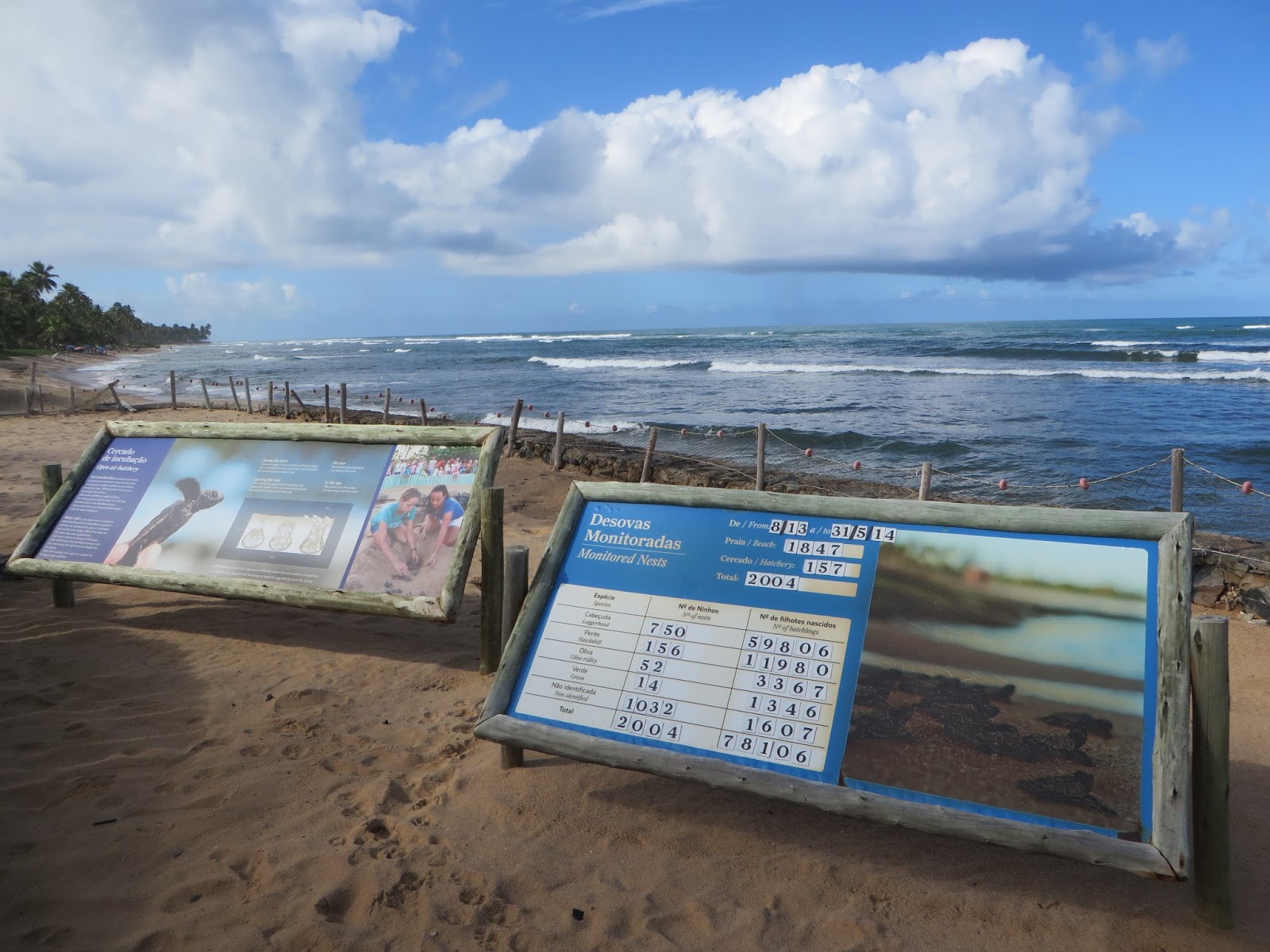
Projeto Tamar is a  turtle conservation project based in the state of Bahia, Brazil. Established in 1980 the organisation has 19 bases covering approximately 1,100 miles of coastline.  Five species of turtle, all of which are endangered, nest on the Bahia coast and Tamar's mission is to ensure research, conservation and management of turtles ensure their best chance of recovering in numbers. Most turtles killed when coming ashore are females ready to nest, killed for their eggs.
Loggerhead Turtle

 Education in helping develop fishing methods that reduce by catch are a vital part of the work done with the local community. As turtles reach maturity at 25 and adulthood at 30 restoring the life cycle and recovering numbers takes considerable time. With the project itself at 33 only just reaching maturity as the first years hatchlings are reaching maturity and breeding age themselves the long term focus of the project becomes clear.


We visited one of the visitor centre at Praia do Forte, one of eleven along the coast. We were outside nesting season which runs from September to March so didn't get to see the work that goes on when the hatchlings make their way to the sea. The visit was still worthwhile and informative.

The project has several tanks for viewing the different species of turtle, being up close with them you can see how large yet venerable they are.
Green Sea Turtle

Feeding time at 2:30 every afternoon is, unsurprisingly a popular activity and a chance to see the turtles up close, commentary is in Portuguese.
Turtle feeding

These hatchlings are one month old and considerably less than the size of your hand. Only one in a thousand of these will reach adulthood.


The project also contains one of only three nurse shark breeding projects in the world, helping long term survival of another slow maturing and threatened species.

Information is scattered around, some in Portuguese but most is translated to English as well, which is helpful for us.  Some of the non translated information is infographic or charts so you can still get a feel for what the numbers say and how populations are increasing, encouragingly.

The project website link is here here for those that would like more detail on the work Projeto Tamar does an the success they are having.

They are even succeeding in predicting world cup results with Halter a 27 year old Loggerhead being selected as the official pitaqueiro for the competition. This fun activity is another way of raising awareness of the need for conservation of these animals. In this case he corctly predicted Brazil would beat Chile, though I doubt he would have predicted it to be as close as it was!

Set up for Halter the Loggerhead to predict the result if Brazil V Chile


Saturday, 28 June 2014

Historic Salvador, our base for the FIFA World Cup

 We based ourselves in Salvador for the duration of the FIFA World Cup group games with a stadium ticket including a second round game and accommodation at Pousada Manga Rosa on the Barra waterfront.  The Pousada (boutique hotel) is right on the waterfront, a perfect spot for the town beach, restaurants and bars.

Founded in 1549 as it's first capital Salvador remained Brazil's most important city for over three hundred years. The wealth that this brought is visible in the gold filled churches throughout the old city.  From the foundation Salvador was built on transportation of slaves and has retained it's African influences of music, dance and arts. Salvador remains one of Brazil's most vibrant cities with a feel very different feel than the south of the country.
Igraja do Santissimo Sacramento do Passo
On arrival we were honoured to be met by one of Daniela's former students, Danilo and his father, Sergio and given a tour of the city on the way to our accommodation. Sergio said Daniela had looked after Danilo during his stay in New Zealand so he wanted to look after us in return, a great introduction to Salvadorian hospitality.

On the way to the Pousada we had to negotiate several roadworks and it soon became apparent that infrastructure improvements that had been planned for the World Cup were still underway. Over the next few days we were saddened that the business at the Forte Sao Diogo end of Praia de Barra had barriers up with the street being dug up in different places every day, the view being obscured by diggers and a constant hum of pneumatic drill. Not the peaceful, scenic place we thought we had booked. There was no way we would spend time on the beach with such disruption.
Once finished the Praia de Barra waterfront will be stunning.
The saddest thing of all was that every day huge progress was being made and you could see that with more organisation and planning it could have been beautiful. It has been incredibly frustrating as a tourist as what is clearly a lovely area has been quite unpleasant to walk around, must be even more frustrating for local businesses. Once finished the wide boulevard they are putting in will be superb and it must be hoped that the city and country benefits long term from infrastructure projects like this. A shame it is too late for the big event.

Our first trip to the Pelourinho, which is the old city was on the day of our first game. The Dutch fans had taken over the main square Terrerio de Jesus complete with live performers on stage. 

The old city is a UNESCO World heritage site and it's steep, cobbled streets and colourful stone buildings, are great to wander around. With churches everywhere you turn I can see why it is said Salvador has a church for every day.  As well as the World Cup our visit coincided with the Festival of Sao Joao (John the Baptist) so the streets were decorated with more than world cup bunting and frequent and random pyrotechnic explosions added to the mood. During the day it is a wonderful place to explore and soak up the atmosphere, though expect to see a lot of street vendors selling the usual tourist trinkets. 

We found a small streetside restaurant for a pre game bite to eat, meat rice and beans, a staple of our diet in Brazil and only 12 Reais, we were able to watch Mexico v Cameroon to get us in the mood.  Arriving at the stadium it encapsulated many of the concerns people have had over hosting the tournament here.  The stunning 600 million real Fonte Nova Arena is overlooked by Favellas showing the stark contrast of hosting the event here.  I will blog separately about the games themselves but in terms of organisation a few more signs directing people and at the first game a few more refreshment kiosks open were the only minor quibles.
Arena Fonte Nova

Early on game day Netherlands v Espana
The following day, Danilo's family further extended hospitality taking us on a day trio to some of their favourite Salvador spots, eating Ice Cream in the historic Sorveteria de Ribeira, founded in 1931. This huge ice cream parlour was packed with locals enjoying the dozens of locals indulging in the dozens of different flavours available.

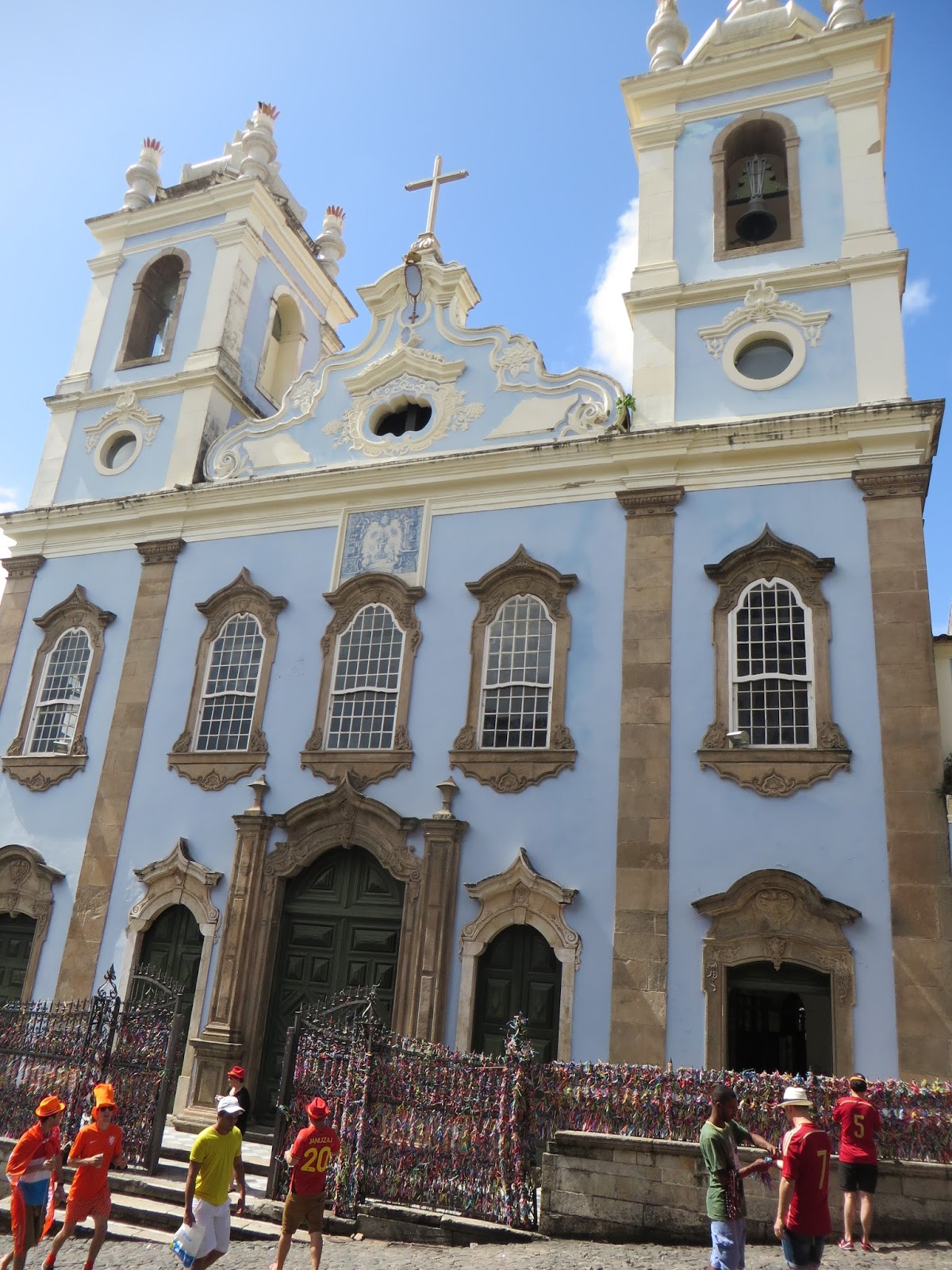
Continuing along the Itapagipe peninsula we visited the beautiful. Igreja Nosso Senhor de Bonfim, the most important church in the Candomble religion. The iron railings are covered in thousands of Fitas, the seemingly omnipresent coloured ribbons which adorn wrists throughout Salvador. They are tied with three knots, each representing a wish which will come true by the time the ribbon falls off. Don't even think about cutting it! Services here are vibrant and melodic, very uplifting.
Igreja de Nosso Sehnor de Bonfim

We watched the sunset over Baia De Todos Os Santos, the huge bay which Salvador sits on the mouth of and which creates (apparently) the only place in Brazil where the sun appears to set over the sea.


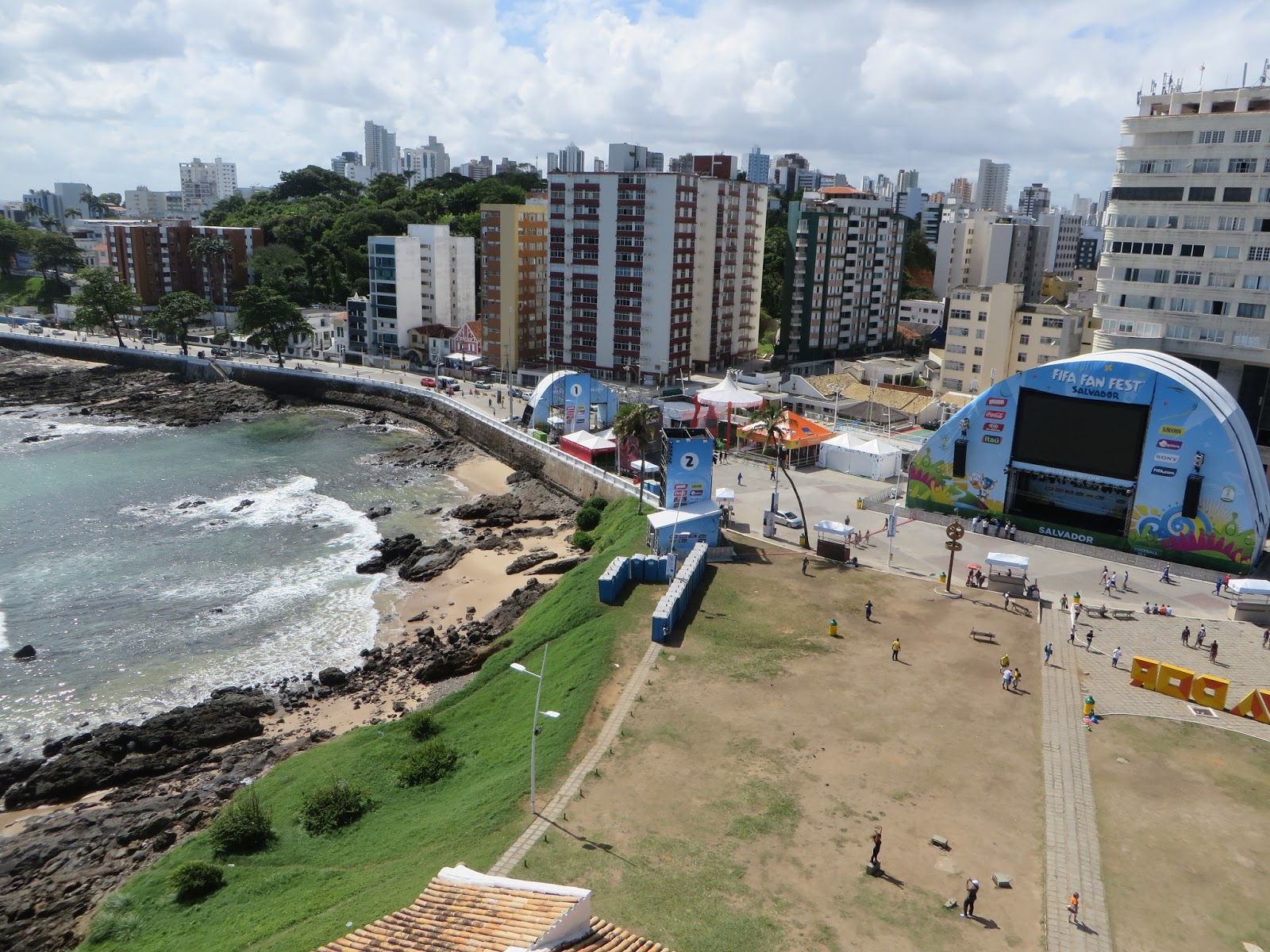
In Barra itself the city had chosen Farol de Barra as the site for the official FIFA Fan Fest ™ where big screens, musicians and a zip line entertained huge crowds on match days. I blogged previously (here  ) on my disappointment that this site wasn't open every day but it was a perfect choice of venue and a complete success when open.
FIFA Fan Fest™ site viewed from Farol de Barra

The Farol (lighthouse) itself sits atop Forte de Santo Antonio de Barra and is home to the city's nautical museum which contains interesting artifacts from the city's seafaring history including the slave trade and an interesting ships in bottles exhibit. How do they do that?  Climbing to the top of the Farol gives a great panoramic view.
Forte de San Antonio de Barra
There is so much more to Salvador, we loved seeing the city embrace the World Cup, we loved the old town and enjoyed the history. Yes there were missed opportunities and the continued construction work around Barra was a disappointment but long term that work will only improve what is a wonderful city to visit.


Monday, 16 June 2014

Rio De Janeiro, one of the top tourist destination cities in the world

If you haven't been to Rio de Janeiro, go. Trust me, just go. If you need more persuasion I'll do my best to do justice to this amazing city.  I have, fallen head over heels for Rio de Janeiro, its people, its vibrance, the food, the beaches, the climate and the views, oh, the views.

View from Christo Redentor to Pao de Asucar
We had six days here and I'm not going to diarise day by day, we saw so much, did so much and still leave behind a list of things we didn't do as long as the one we did. I always try to arrive somewhere new with as few expectations as possible, places are never quite what you imagine but somewhere as well photographed and as famous as Rio challenges this. The big ticket items, Sugarloaf (Pao de Asucar), Christ the Redeemer (Christo Redentor) and Copocabana are so well documented you can close your eyes and picture them before you get here.

We stayed in the bohemian hillside barrio of Santa Teresa, away from the most popular beachside suburbs of Copocabana and Ipanema where most visitors stay. We chose Santa Teresa partly on price and partly as it's laid back, chilled out reputation suits us better. We couldn't have made a better choice, Villa Leonor was a home away from home for a week with stunning city views and a very laid back vibe.

Villa Leonor, Santa Teresa
The stairs back up the hill were hard work after a night out in the vibrant samba party barrio of Lapa.  It seems every night is party night in Lapa, dancing in the streets, great weekend night markets selling good cheep food and bargain drinks to revellers out on the streets.
Vibrant street art, Lapa
The Centro area has a reputation for being quiet and a bit rough at the weekend and it makes sense to stay away from anywhere that is quiet in a big city. During the week though it is a typical busy business district with a wonderful feel to it, busy but still with the laid back South American feel that nobody is in too much of a rush. There are plenty of museums and art galleries, including currently a Salvador Dali exhibition at the Banco de Brazil cultural centre, so Sao Paulo doesn't have claim to all Brazil's culture. There are plenty of street side restaurants selling good value Executivo lunches to keep you fuelled.


So what of the big ticket items? Unlike most people we preferred Copocabana to Ipanema, it's wide boulevards and long curved beach are simply stunning, it offers a better range of beachside cafes and seems to revel in it's own take me as I am brashness where Ipanema tries to be the cool fashionable area, scenicaly possibly nicer but architecturally, not as attractive for us.
lively, brash, stunning Copacabana
Having lived away from Europe for so long it was amusing to see hawkers selling food, drink and souvenirs and vendors with their patch hiring deckchairs and sun shades. Great fun to see but I can't imagine these commercial activities on New Zealand beaches!

Observing the football kick abouts it was hard to know if this was a normal level of activity or World Cup related.
Kick about on Ipanema beach, count the balls

Visiting Christ the Redeemer or Christo Redentor using the tourist train provides amazing views and is a fun ride, the train is well serviced by local buses so there is no need to use a tour to get there.  We'd kept an eye on the weather forecast to get the clearest skies possible, for us a priority that trumped the recommendation not to go at the weekend to avoid the crowds.  Christ himself is the largest art deco statue in the world and is stunning, a marvelous piece of architecture overlooking a stunning city scape on one of the most spectacular harbours imaginable.
Christo Redentor or Christ the Redeemer
The views towards Pao de Asucar are breathtaking, and you can see why these views are some of the world's most famous.

Pao de Asucar or Sugarloaf
Bearing in mind we are here for the World Cup, the view over Estadio Maracana, one of the worlds top iconic sports stadia is quite spectacular.

Estadio Maracana
Views from Pao de Asucar are equally spectacular, as is the cable car ride up there, and the perspective on the city is so different I highly recommend doing both viewpoints.


There were plenty of football fans impressed by the England training camp and strained views of the team training far below. Being with so many fans of different countries it was clear the city was really getting into party mode.

Not a bad spot for some pre tournament training
Transport around Rio is easy. Apart from our taxi from the bus station that on arrival let's give him the benefit of the doubt and accept his reasoning for the long circuitous route as 'avoiding traffic' it couldn't be smoother.  Buses are easy to come by, operate a fixed fare per ride and go to all areas of the city. The metro, though a bit of a walk from our hostel is even better, clean, frequent, cheap and completely safe.  It is a city with everything, art, culture, bars and restaurants as well as spectacular beaches, chill out, explore or party the night away.  If there is a city that offers more to tourists than Rio de Janiero I haven't been there yet.

Estadio Maracana World Cup final venue 1950 and 2014, Flagged for Enzo