Showing posts with label #blogger. Show all posts

Monday, 11 August 2014

Cyclovia, the South American tradition where cyclists take over the road every Sunday

One of the things I love most about South America is the Sunday Cyclovia.

Most major cities close a significant part of their road network to motorised traffic, opening up tens of kilometres, in some cases over 100 kilometres of prime city centre infrastructure to cyclists, skaters, runners and walkers. When I say major cities I am talking about Buenos Aires and Sao Paulo both with populations of over 10 million and I'm talking about major highways, dual carriageways, flyovers and other major arterial routes.  Sao Paulo takes in Avenue Paulista one of it's most iconic stretches of road through the CBD which buzzes with thousands of workers and shoppers during the week
Quito Cyclopaseo, La Mariscal

This is of course possible because most retail and offices are closed for the sabbath meaning the disruption is somewhat reduced.  Many of these cities already have significant cycleways in place in the first place, dedicated lanes separated from the traffic making cycling a genuine safe way of commuting that cyclists in many major cities could only dream of rather than a white line gently suggesting traffic give room to cyclists.
Quito cyclists make use of the roadway as well as dedicated lanes

Bogota, Colombia is credited with the inspiration for the Ciclovia, closing streets in the city since 1976. As one of the worlds most bike friendly cities it also has around 350k of dedicated purpose built bike lanes. It is estimated that 2 million people (about 30% of Bogota's population) use the weekly Ciclovia where 120k of city streets are dedicated to cyclists.

The Cyclopaseo in Quito coincided with our first day in the city and it was a great experience to walk from the La Mariscal area up to the historical old city via Parque El Ejido following the Cyclopaseo all the way.  The path here runs north south joining the new business district with the old town and is used by tens of thousands of people adding to the festive atmosphere as it winds it's way along the path.
Cyclopaseo  near Parquet El Ejido

Quito Parquet El Ejido

Many towns and cities in South America are still built around streets where individual trades are based, the mechanics street jewellery street are a couple of examples.  I was amused to see a collection of cycle shops in one area all doing a roaring trade with services and puncture repairs.
On road repairs

Seeing so many people out enjoying their city on two wheels is something to behold. Seeing serious cyclists mixing with BMX riders, families on a mix of racing, touring and kids bikes along with runners and roller skaters has been one of my favourite sights in South America and though Quito, pictured in this post is the only one I've seen in full flow the glimpses I've seen across the continent leave me in awe of their ability to make events like this happen every week.
Quito centro historico

 Incredible, forward thinking use of the city spaces with an impact on people's health and well being that must be enormous.

Thursday, 7 August 2014

Tejo : A Colombian sport involving, gunpowder, explosions and beer. Get In!

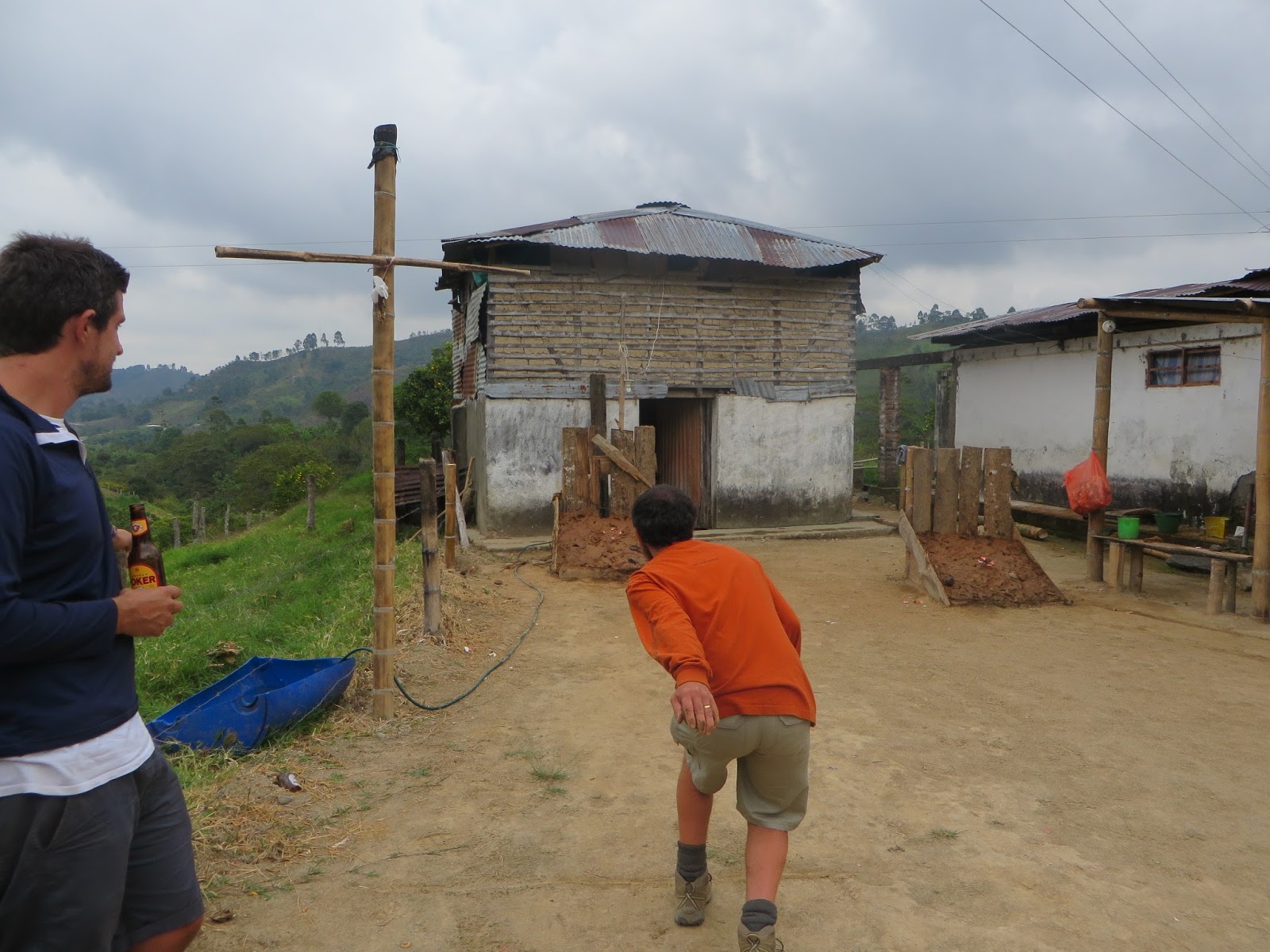
On discovering that Colombia's national past time involves drinking beer while throwing heavy metal objects at gunpowder filled targets I knew I had found the sport for me and the search for a game was on.

Origins of Tejo (Te - ho) are uncertain but may have involved indigenous people throwing gold discs at targets.  The modern form of the game involves throwing a large metal disc (Tejo) weighing approximately 680 grams across a pitch of twenty metres.
A tejo
The target is a wooden box approximately a metre square and filled with heavy clay.  Within the clay is set a metal ring upon which are placed paper triangle packages filled with gun powder.


The target
Hitting the ring with the Tejo causes the gunpowder to explode with a spectacular flash and bang.  Neat, eh?  Drinking beer and shouting loudly is also compulsory.
I first came across Tejo at the end of our Ciudad Perdida trek catching a brief glimpse of a game.

The game is hugely popular in central Colombia and arriving in the Zona Cafetera was always going to provide an opportunity, fortunately being savvy to traveller needs many bars and Coffee plantations have established the enthusiasm of backpackers for beer and explosions so Tejo courts are not hard to find.

We visited the Don Elias coffee plantation for a tour, this is about a 45 minute walk out of Salento so the invite for a beer and a game of Tejo was never going to see much resistance. We played at La Aurora a new restaurant starting up just on the left before Don Elias. The guys there were great, explaining the rules and tactics to us before letting us loose.
Professional Tejo Technique


Mad Skills

Having only met one other Kiwi in South America we have now met four in three days and joined a couple from Wellington for a 'torneos Relampago' as the tournaments are called.
One point to the Kiwis

There is an official scoring system of points for nearest the metal ring, landing in the metal ring and of course explosions.  We eventually lost 21  - 16 after a hard fought battle.

Shameless plug for our hosts at La Aurora


Tuesday, 5 August 2014

Colourful fresco adorned buildings and stunning lake views in Guatape

Guatape is an easy and popular day trip from Medellin for locals and tourists alike, a number of door to door tours are available but we chose to take the local bus. We arrived at the bus terminal on the metro and got lucky as a bus was leaving immediately.

The journey itself was another incredibly scenic journey, I have run out of superlatives for this beautiful country. The highest praise I can offer is that it is up there with New Zealand as the most striking country I have visited.

As well as the town of Guatape itself the area is largely visited by people seeking the view from the top of Piedra del Penol, 'The Rock' which is a 200 metre high black rocky outcrop sticking high above the surrounding rivers and lakes affording, so we are told, the best views in the world.
Are you ready for this?
Piedra del Penol - The Rock

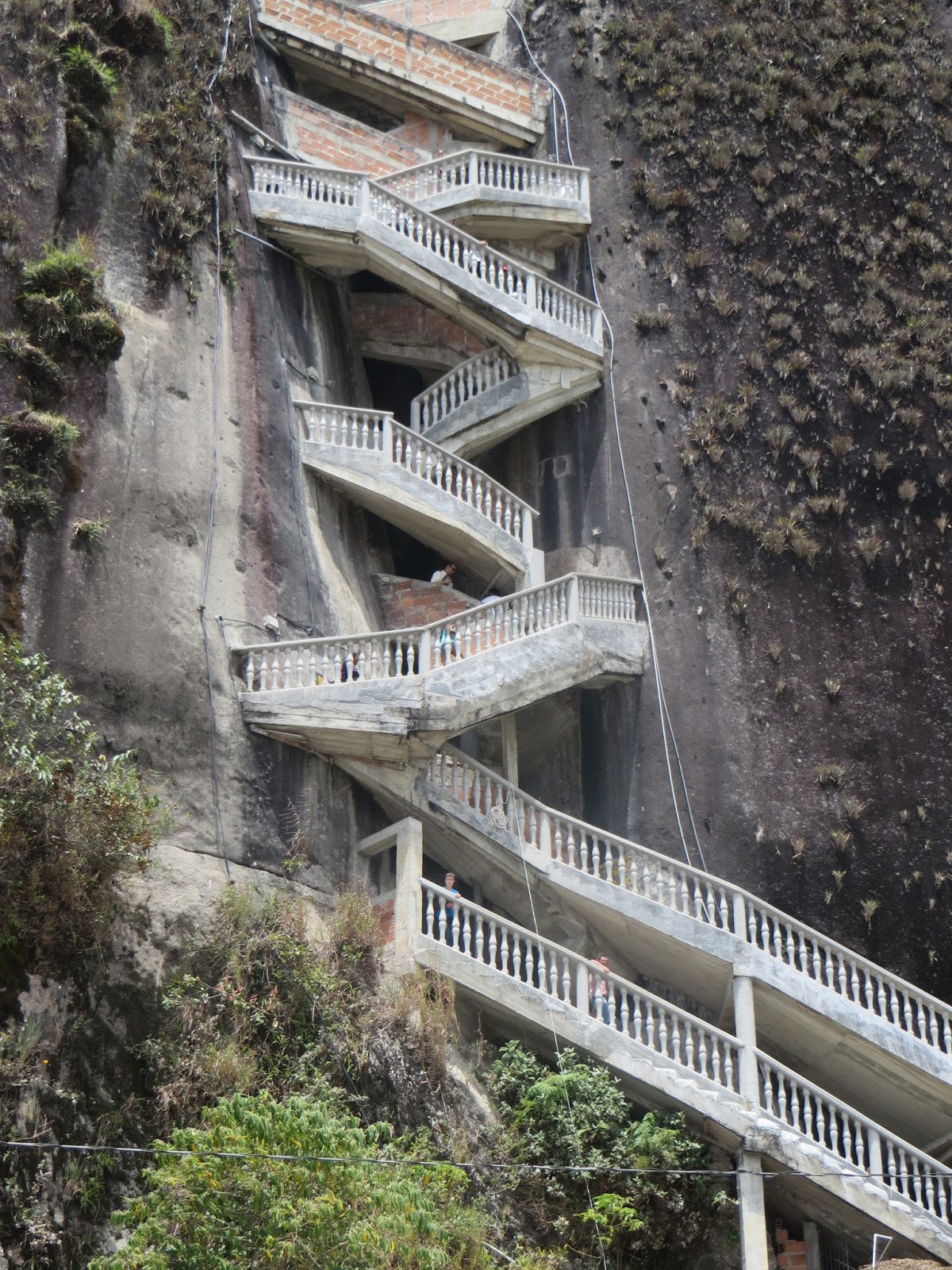
The rock is scaled and descended via steep brick staircases (one up, one down) built into a crevice in the side of the rock. Though not a high climb it is fairly tough but well worth the effort, though I would debate the equally steep 10,000 COP fee.

The views from the top are wonderful with fingers of water jutting into the landscape in all directions.
The best view in the world
Some more of the best view in the world
Moving on to Guatape there are motor taxi (tuk-tuks) or regular collectivos servicing the route. We chose the collectivo and I wasn't remotely concerned that being full my 'seat' was standing on the bumper holding onto the roof rack, I was quite glad it was only a ten minute journey but what a great way to travel.

Guatape itself is known for its brightly coloured buildings with many of the streets having brightly painted bas relief carvings adorning their street front.

Many if these identify the trade of the home owner or the shop in question.
Ironmonger and Agricultural supplies

Each street is a little different and creates an interesting walking tour of the town.

The town square is a pleasant place to take in the passing people and the lakeside provides a great spot where you can watch zipliners being pulled across to a tower on the far side of the lake and streaming back down again.

Every town has a Simon Bolivar statue, Guatape's is one of my favourites

A perfect place to wander and chill or do more activities such as take a boat tour on the lake, we took the former option and thoroughly enjoyed our day.

Monday, 4 August 2014

Medellin, a city with many challenges but definitely on the up

Medellin is a city going through long term change making now a fascinating time to visit. Once the capital of the world cocaine trade Medellin had the unenviable reputation of having the highest murder rate in the world as it was held under the grip of Pablo Escobar's cartel. It is said Escobar offered $1,000 for every police officer killed, with approximately 3,000 killed during his reign. Escobar had a reputation of being a hero to the poor, funding building of schools and other 'philanthropic' projects. Even ten years ago much of the surrounding area was under lockdown, impossible for local people to travel in their own district much less tourists. There is plenty of information elsewhere on the history of the region but like the rest of Colombia travel is now open and deemed safe in the area with business thriving and tourist numbers on the increase every year.

Arriving on the overnight bus from Cartagena afforded spectacular early morning views.  As dawn broke over the steep vallies on both sides we wound our way over the winding mountain pass, it was almost surprising to only see one truck embedded in the embankment. I always think people who sleep through bus journeys miss some of the most rewarding experiences that travel offers. You have certainly missed out if you have slept through this journey.  Medellin itself sits in a long narrow valley with red brick and tiled Comuna ( equivalent to the term favella) reaching high up the valley sides.  A huge unsettling contradiction of the poverty of these homes making the city look beautiful, it is one of the most spectacular settings for a city.

Early morning view over Medellin from 61 Prado

Arriving at Terminal Transporte de Norte affords easy transit to the Metro. Colombia's only metro system affords clean, safe, easy and cheap transport across the city. It also contains the Metrocable (more about this later) in my experience a unique addition to the public transport system. A good metro system makes the biggest difference to getting around a city and South America seems to do them particularly well.

Medellin Metrocable

We chose not to stay in the popular backpacker area of La Poblado, largely because of the lack of private double rooms available.  Our choice of 61 Prado wasn't quite what we expected as it is in the process of shedding it's Hostel set up and re branding as a more upmarket guesthouse. Our plan to save money by cooking was foiled as they have replaced the guest kitchen with a cafe. The guesthouse affords spectacular views over the city from it's roof terrace.
View from 61 Prado roof terrace
First on our to do list when arriving in a new city is to acquaint our selves with a walking tour so obtaining a decent map is always a priority.  Having failed at the bus station we were disappointed our guest house didn't have one either.  At this point we were told not to walk to the city centre (other than taking a long circuitous route) as the area between us and the City Centre was rough.  The council had recently evicted many homeless people from buildings they were occupying leaving a large homeless, drug and prostitution problem on the streets in this area.

Feeling slightly edgy we headed off on the long route round and certainly felt an edge to Medellin which lasted our whole time here. While never threatened, directly approached or treated aggressively we were on our guard most of the time we were here. Bolivar Park was not somewhere we would sit to shade from the sun with a lot of homeless people and some overt marijuana smoking taking place.

Having enjoyed the excellent and free Museo Botero in Bogota (Botero's Mona Lisa - Here) so much we were keen to see more of Fernando Botero's work.  The Museo de Antioquia is 10,000 COP entrance and if you are a particular fan of Botero or have not made it to the museum in Bogota is well worth the visit. If you are on a tight budget and have seen the Bogota gallery, you could give it a miss but Plaza Botero is well worth some time. Large sculptures of some of his best known and most amusing works line the square.  Mime artists and street vendors give it a lively feel.
Plaza Botero

Day two we headed back on the metro towards the Metro cable to visit Paque Arvi.  The Metrocable is another of Medellin's forward thinking public works projects.  The steep valley sides made some of Medellin's poorest and most violent areas hard to access and difficult to get around.  Determined to improve links, accessibility and safety the city literally built a cable car up the valley sides with stations at important points along the way.
View from Medellin Metrocable of the areas it was build to reinvigorate

I have been in many cable cars as tourist attractions but seeing one in everyday use as a public transport system linking the poorest neighbourhoods to the central metro (one stop from the hospital) is unique in my experience and very inspiring. It is acknowledged to contribute to improving lives of those it serves.

The Metrocable was also continued beyond the city a couple of killometres deep into a pine forest used for leisure and recreation. As a tourist you have the contradiction of viewing the poor favellas while heading into the park.  We had an interesting conversation with one of the locals wishing us a safe journey and helping to explain to others in our car where we are from.
Metro cable high above Arvi Park

Arvi Park itself is worth visiting for the cable care journey and views of the city and park alone.  We took a short, slow paced guided walk through some of pine forest, though other activities such as visiting the lake require further costs and onward transport.

We took a day trip to Piedra de Peno and the picturesque town of Guatape, which I will write about separately.


Our last night in Medellin we were taken out to J&C by Melissa, one of Daniela's former students, our fourth Worldwide School reunion of the trip so far having met former students in Montevideo, Sao Paulo and Salvador. Melissa's mum and aunt picked us up from our guest house and took us for the most amazing arepas, easily the best we have had in Colombia.  We had a great evening chatting away with Melissa interpreting where necessary. We were fortunate and honoured to have such a warm welcome to their city. Such hospitality makes you feel so welcome in someone elses country it leaves a very special memory.

In our time in Medellin we saw the bright modern city moving forward with the rest of the country and also saw a city struggling with many social issues but making great strides to deal with this, we loved the stunning setting and met many wonderful people the long term future will take a lot of working towards but looks bright.


Sunday, 20 July 2014

Bogota, Colombia: An introduction to a city and a country on the rise

Few, if any countries have a more violent war torn history than Colombia. From the time the first conquistadors arrived in 1499 there has barely been a time of peace and stability in Colombia. There is plenty of literature on the Spanish colonisation and the Simon Bolivar led fight for independence, gained in 1819. Civil wars raged through the 1800's as different ideologies fought for the future of the country, upwards of 100,000 were killed in the war of a thousand days which spanned the dawn of the 20th century.  A period of calm ended in 1948 with the beginning of La Violencia which ultimately ended in the deaths of over 300,000 people as liberals and conservatives continued the battle for control. A power sharing agreement controlled the political debate, for a country with a history so steeped in violence debate it is not surprising that this led to guerilla groups such as FARC gaining support and power as they refused to allow the mainstream the control they sought.  The country's violent history further deteriorated in the 70's and 80's as the drug cartells became the most powerful and richest organisations in the country. Headed first by Medellin based Pablo Escobar, and after his death in 93 the Cali based cartels tens of thousands were killed in the battle for the trafficking trade. During this time Medellin and Cali had the highest murder rates on earth. The drug trade still exists but the cartells are now broken, FARC are at the political table, the economy is booming and a period of long overdue calm seems a distinct possibility.

Few, if any countries have a more violent war torn history than Colombia. From the time the first conquistadors arrived in 1499 there has barely been a time of peace and stability in Colombia. There is plenty of literature on the Spanish colonisation and the Simon Bolivar led fight for independence, gained in 1819. Civil wars raged through the 1800's as different ideologies fought for the future of the country, upwards of 100,000 were killed in the war of a thousand days which spanned the dawn of the 20th century.  A period of calm ended in 1948 with the beginning of La Violencia which ultimately ended in the deaths of over 300,000 people as liberals and conservatives continued the battle for control. A power sharing agreement controlled the political debate, for a country with a history so steeped in violence debate it is not surprising that this led to guerilla groups such as FARC gaining support and power as they refused to allow the mainstream the control they sought.  The country's violent history further deteriorated in the 70's and 80's as the drug cartells became the most powerful and richest organisations in the country. Headed first by Medellin based Pablo Escobar, and after his death in 93 the Cali based cartels tens of thousands were killed in the battle for the trafficking trade. During this time Medellin and Cali had the highest murder rates on earth. The drug trade still exists but the cartells are now broken, FARC are at the political table, the economy is booming and a period of long overdue calm seems a distinct possibility.

With such a tragic history I am intrigued to have been hearing stories over the last few years of Colombia being the new kid on the block of best countries to visit and  find out.Travellers we've met all rave about what a wonderful place to visit. What's changed? I can't wait to find out.
Bolivar Square, Bogota
Arriving in Bogota's modern airport where even the baggage claim area is bright and airy I felt I was pulling for breath in the high altitude air straight away. It felt fresh and good. Arriving in a country where even the smallest transactions are measured in 000's always takes some getting your head around but the 35,000 COP taxi fare to La Calandaria seemed good value.

Sayta Hostel where we stayed is at the end of La Calandaria, the old part of Bogota city, home to most of the main tourist sites and centre of the main backpacker scene. We were greeted at Sayta Hostel with a warm welcome and hot coffee. An early afternoon check in gave us time to go for a walk and get our bearings and a feel for the area.  We both felt Bogota had more of an Andea influence than we expected, feeling more like Lima than the cities of Brazil or Argentina, the cool thin air added to the different ambiance of the city, it felt good. Having had a nightmare journey to Bogota involving a 24 hour delay over almost two nights at Brasilia airport we were ready for a feed and a sleep. We settled in to one of the areas many cafes and ordered Ajiaco a chicken and potato soup served with rice and sour cream, which is one of the areas speciallities. It was just the job before we crashed onto a deep sleep.

Breakfast will be one of the other adjustments of arriving in Colombia, after the sumptuous breakfasts included in the room price in Brazil breakfast is rarely included in Colombia and where it is bread, jam and coffee is the staple. I started chatting to Eva and Kevin an Irish - Australian couple who were early arrivals on the overnight bus from San Gil our next intended destination. We'd end up spending more time with them over the next few days, I straight away knew they would be great fun.

We visited the Museo de Oro first, considered the biggest and best gold museum on the continent it covers displays of jewelery and statues as well as covering history of discovery and development of metallurgy. There is an interesting display on the role of shamen and the use of gold in their rituals.
Anthro - Zoomorphic - Breastplate

After a traditional Almuerza lunch of fish soup and fried Piranha we visited the police museum. Free to enter but seemingly only available to tour with a police officer as a guide, there is an interesting history of the development of the Colombian police force, created by the same person who created the inaugural police force in France.  Further information on the evolutin of police eligebility rules and training programmes are also in place. Next our guide took us through a kind of hit parade of the most dangerous criminals with their capture or despatch date, clearly a sense of pride for the force.
There is, of course, a room dedicated to the tracking down and shooting of Pablo Escobar, the most satisfting result for the force.  Artifacts include gold encrusted pistols use by his top henchmen, his nephew's gold encrusted Harley Davidson and more macarbrely the jacket Escobar was wearing when he was shot and a bloodstained tile from the rooftop where he fell. Escobar shot first, apparently.
Pablo Escobar's jacket

Pablo Escobar's Harley Davidson

For me the most interesting exhibit was a satelite map of Medellin showing the sites of the last seven phone calls Escobar made as the police narrowed down his location.  We felt a little rushed. through and the guide was reluctant to allow us more time to walk freely through so I'd say it is worth a look but not overwhelming.

Carrera 7, one of Bogota's main thoroughfares is closed to traffic and creates an area for traders, food stalls and entertainers to gather, creating a long open boulevard busy with downtown workers as well as tourists. As part of this set up there are dedicated cycle. lanes of which Bogota has over 350 killometres. As part of one of the most progressive forward thinking transport infrastructures in the world these lanes are seperated from traffic, not just a line on the road. A further word on transport Bogota has, as Eva put it, effectively created a tram system without laying down tracks, they have built vast dedicated bus lanes running in all directions down which huge buses travel at regular frequency enabling passengers to zoom across town with no congestion issues. Good work.

At this point we stumbled on the Guinea Pig gambling. A slightly surreal experience where a fully miked up 'trainer' has a selection of guinea pigs several yards from twenty upturned bowls each with a small entrance.  The trainer encourages the audience to place money on the bowls in return for which they take a slice of the winnings should a guinea pig select your bowl, as far as I could tell the bigger your stake the larger your share of the takngs. Unfortunately I never got the chance to confirm this despite one runner giving my bowl a sniff on it's way past.


Next on the list was the Torre Colpatria, Bogota's tallest tower block allows access to it's roof terrace affording great views over this vast (7.5 million pop) city. With mountains to the east and south and the flat plains to the north and west the scenery changes dramatically but the city stretches in front of you almost as far as across the plains.  The most noticable building below is the bullring with it's moorish facade standing out amongst the rest of the surrounding architecture.  Apparently no bull fights have been held for the last couple of years as public opinion against the sport grows.
Santamaria Bullring
We met up with Kevin and Eva, along with Rob a German friend they had met in Mexico. We sampled the Paisa a traditional Colombian dish consisting of Chicken, pork, pork belly just in case you were low on protein!

Sunday brought World Cup final day so all activities were timed for the 2pm local time kick off.  It was a good day to climb Mount Monserrate, a 1500 stone step climb to a church up above the city, the weather, as it seems is typical of Bogota was cool with spells of rain blowing through meaning views were not guaranteed. The walk is a traditional weekend family activity in Bogota so these are the advised times to go rather than midweek when it can be very quiet. We took the opportunity to take on board some coca tea at the bottom, apparently it helps with any ill effects of altitude. Though there are plenty of stalls selling drinks and snacks on the way.  I found the climb tougher than I normally would, certainly finding myself slightly short of breathe due to the altitude. It is a great walk with plenty of plenty of places to stop on the way if you need a rest and to take in the ever expanding views of Bogota below. At the top the Monseratte church was holding mass which was an obvious attraction for many Colombians making the journey.
After the climb up Mount Monseratte, tired, wet and happy.

Joined by Eva, Kevin and some random excited Colombians

Religious buildings and services often provide some of the best photo opportunities though I am always unsure of the etiquete regarding taking pictures. So many religious buildings are beautifully architecturally designed and decorated structures and gatherings are some of the most colourful yet I always feel intrusive taking pictures, despite plenty of others normally also doing so.  I would be interested to know peoples thoughts on this.

After a more relaxing walk down we sought out a small local restaurant for the traditional Colombian Almuzera of soup and a main dish of meat, rice potato and normally fried banana or plantian. We then found a bar to watch the world cup final over a few beers. A great game with both teams coming out trying to win it. Argentina pushed them well but Germany proved worthy winners, being consistently the best team through the tournament. A fitting end to a great tournament.

Our last day in Bogota we decided to hang around La Calandaria and to visit the Museo Botero.  Fernando Botero, one of Colombia's best known artists had a penchant for sculpting and painting 'fat' objects, fat people, fat fruit, fat musical instruments and fat animals. He donated a collection of his own works as well as some internationally renowned artists such as Degas, Picasso, Dali and Monet.
Fernando Botero's Mona Lisa

Fernando Botero's Caballo

The museum itself is set in an old colonial house with airy balconies over looking shady courtyards. I'd recommend it as a must on any to do list for Bogota.
Museo Botero
Leaving Bogota we were ready to move on but it is an enchanting city which is clearly on the rise, I could easily have spent more time in. A wonderful introduction to Colombia which left me more excited than ever about what the country has to offer.


Wednesday, 16 July 2014

Brazil v Colombia, a big night out in Lencois

We left Salvador and headed inland to Lencois on a high after our last World Cup match USA vs Salvador, one of the best matches I've been at. 

I have detailed the Parque National Diamantina HERE but Lencois itself is worth a mention. A seemingly quiet town it is very much on the tourist trail and has a number of hotels, hostels and camoing to suit all budgets and travel styles. The number of tourist doesn't detract from the steep, narrow cobbled streets where restaurants spill out into the street at night. 

The covered market and several squares each form part of the local community social activity with people gathering to meet or passing the time of day. Many of the tour agencies and other businesses only open in the evening once the tourists arrive back from their treks and tours of the park giving the place a pleasant natural feel during the day.

Having witnessed most of the World Cup in the host city Salvador it was great to get a different experience watching Brazil v Colombia quarter final here. TV's were set up outside and together with Flyn, Rachael and Justin from our hostel we found a bar with seats out in one of the main squares next to the covered market, a perfect spot.

The town started filling with yellow as kick off approached with both visitors and locals sporting the Brazil colours.  As the players were warming up the local drum band marched out of the covered marked and gave a full blooded display getting the crowd worked up.

The game itself was tense with nerves all round. An early goal from Thiago Silva sent fire crackers screaming through the town, fireworks bursting from the hillside and significant beer spillage. Colombia had earned a reputation as one of the flair sides of the tournament and even though they looked nervous Brazil knew the danger was still there. A second goal mid way through the second half for a 2-0 lead was enough for another round of firecrackers, fireworks and beer spillage.  A late James (Ham-ez) Rodriguez goal was enough to quieten the crowd and only as full time ticked over did chants of BRAZIL BRAZIL BRAZIL echo through the square, on full time queue more firecrackers, more fireworks, more beer spillage and a return of the drum band on even more full blooded form than before. There was definitely a feeling of relief as much as joy as they had known Colombia were a form team.  

Dancing erupted in the street and the band, pied piper like headed off into the town, returning some minutes later with more people in tow. They took up position and the whole town, and bemused tourists burst into dance, led by one of the band leaders in what looked like a bizarre group aerobics workout.

Later in the covered market a fantastic Capoeira display broke out with the local club ranging from small children to honed experts facing off raising excitement levels further. Capoeira is a dance mixed with martial art with moves involving high kicks and somersaults. It is a staple of the province of Bahia, though I felt this was more genuine than the made for tourist displays in Salvador.


The town was clearly in the mood to party. Open backed Utes drove past with people dancing and playing Saxaphone in the back, youths honked their horns and a good time was had by all.

It was a pleasure to be in such an amzing country for the World Cup and sharing this night with Lencois was one of the craziest nights of all.