Monday, 26 May 2014

Bonito, not so bonito in the rain

Bonito has a reputation for being the hub of eco tourism in Brazil. The area is famed for crystal clear waters and a huge variety of fish making for spectacular snorkeling. The more adventurous (and those able to stretch the budget) can rappel into big sink holes for amazing diving. As an attempt to preserve the water clarity sun block and mosquito repellent are not permitted when entering the water on some activities, wetsuits are provided to offer protection and warmth. The trip to Bonito on Vanzella stretched from the promised three hours to four and a half, not a major drama but the first of a number of incidents where Gil from Pantanal Discovery's smooth sales patter didn't quite get borne out in reality. Bonito, described in the guide book as tiny was larger than we expected, not a big place but more than a one street town. We checked into Papaya Hostel, a new kid on the block and one which is bound to raise the bar for budget travel in the area, Jenny and Carlos have done a great job with the set up. Jenny set up a tour of Rio da Prata, which has the best snorkeling for the following morning but warned us it wouldn't be at it's best due to high rainfall creating muddy run off into the water over the last few days.
We jumped straight on the hostel bikes (small hire fee) and headed out of town for the Balneario Municipal, a natural swimming hole in one of the rivers where big schools of Piraputangas gather. On arriving we were disappointed as the murky water looked nothing like on the posters. Clear azure waters with people frolicking in the sun were replaced with River Thames brown waters with people unsure whether to dip a toe in.
Jumping in at the furthest upstream point I was straight away surprised by the strength of the current, though the speed is patchy and slows down after the main bend so it is very safe. The size and quantity of fish was good, though with visibility of only a metre certainly not what I'd come for. The biggest disappointment was that most of the fish were gathered within a metre of shore as people were buying food at the entrance and throwing in bag after bag to attract the fish for photo opportunities. This is certainly not a natural experience and not eco friendly in anyway. 

Encouraging mass feeding is a big black mark for the eco reputation in my book and should be stopped. After our afternoon arrival dusk was drawing in as we cycled back to town which made the ride back different and enjoyable though I wouldn't have wanted to be much later. On arriving back at the hostel Jenny gave us the bad news that the Rio da Prata trip was cancelled due to the water quality, which, given this was our reason for coming was a bit of a blow. We were offered an alternative of snorkeling the Sucuri which doesn't have the same number of species or size of fish but usually retains better water quality in poor weather. It seemed the options were to write Bonito off completely or take a chance on this and something seemed better than nothing. Jenny, again made all the arrangements and we were set for the following afternoon.

Heading to a bar for a drink seemed the sensible option at this point. We settled on Taboa a cool looking bar covered inside and out with graffiti, every surface was marked with dates and names of people who had passed through, I couldn't help wondering if someone I knew or had crossed paths with had left their mark there. The plan to head to a quality fish restaurant was abandoned after the first Capiraniha.

 I'd first heard of Capiraniha's when my brother visited Salvador as a stopover when sailing Clipper Ventures round the world yacht race. The tales of Victoria Clipper had me spellbound and with Brazil always on my list of places to visit, hearing the stories of their first major stop over was fascinating. Having our World Cup tickets in Salvador will be like tying another knot of family connection, I can't wait to see the harbour where the Clipper Ventures crews were based.

 Another Capiraniha left us quite happy, could it have been possible they were getting stronger? The morning. was spent catching up on a few bits and pieces, wandering round Bonito we couldn't resist taking a picture of the town fountain complete with statue of giant fish, New Zealand and Australian towns love having statues of large local items of interest in a prominent positions. The capitals of Europe can keep their victorious generals on horse back, their Kings and their Queens, the cities of South America can keep their liberators, the Big Fruit of Cromwell and Giant Ohakune Carrot do it for me every time!

 Typical. As the time for our trip approached the storm clouds opened, the heavens opened and lightening filled the air. We drove the 16 k to Rio Succuri in pouring rain, watching the gulleys on the side of the road fill with orange red run off. We felt our chances of crystal clear waters were slim to none. Arriving at the river side base we were treated to an Armadillo walking across the lawns, the first we had seen. We waited for a while for the previous trip to return then were kitted out and headed off to the boats. The Rio Sucuri trip differs significantly from Rio da Prata, firstly it is an hour, 1k snorkel rather than a 3k two and a half hour snorkel. An hour is a long time in fresh water which cools the body much faster than salt water, two hours plus is a very long time. Also Sucurri begins with a trip in canoes which provide great views of fish and bird life as you make your way upstream. Rio da Prata begins with a 45 minute walk making it a much longer trip. The paddle through close jungle was fantastic, big herons on the river banks and big weed beds floating in the stream of water made it feel like making your way through pristine jungle. The complete quiet except for the lap of the water and the chatter of the birds brought a hush over us all.

We reached a moored wooden platform, climbed out of the boat and one by one slipped into the water. The water was clear and immediately abundant in large fish. Swimming is forbidden along with touching the bottom, again in order to preserve water clarity. Gently floating down the river, allowing small movements to move closer or further away from the banks and in and out of the current was a first for me. Other than taking my PADI diving course in Capernwray in Lancashire all my snorkeling has been in salt water. Allowing yourself to drift amongst the reeds (the larger fish are under weed and tree branches on the water's edge) was spectacular also giving the best view of tiny electric blue and luminous red fish nearer the surface.
Given the advice that Rio Sucuri was less spectacular and the run off from the rain I was impressed with clarity and viewing. I would say if you are not as confident in the water an hour is enough and the boat ride is beautiful making this an excellent alternative to it's, supposedly more spectacular cousin.
Back at the hostel a hot shower was most welcome especially when followed immediately by a Capiranhia. It was BBQ night at Papaya Hostel, Rafael, Carlos' brother played host and kept us topped up with drink and fantastic BBQ meat, chicken, steak and sausage. As well as us he hostel was playing host to guests from Holland, Germany, Israel, Switzerland and Egypt and Argentina. A great opportunity to mix with different people and a perfect time for the Argentinian to add more languages in which he could say "You have beautiful eyes". A pick up artist maestro. There was some debate as to the value in my teaching him that all Aussie girls need to hear is "stick another prawn on the barbie" to make them go weak at the knees. So

Bonito had been good but not great, we hadn't realised how weather dependent it is so if you go, check in advance and be prepared to be flexible.

Sunday, 25 May 2014

Campo Grande, often overlooked but worth a stopover

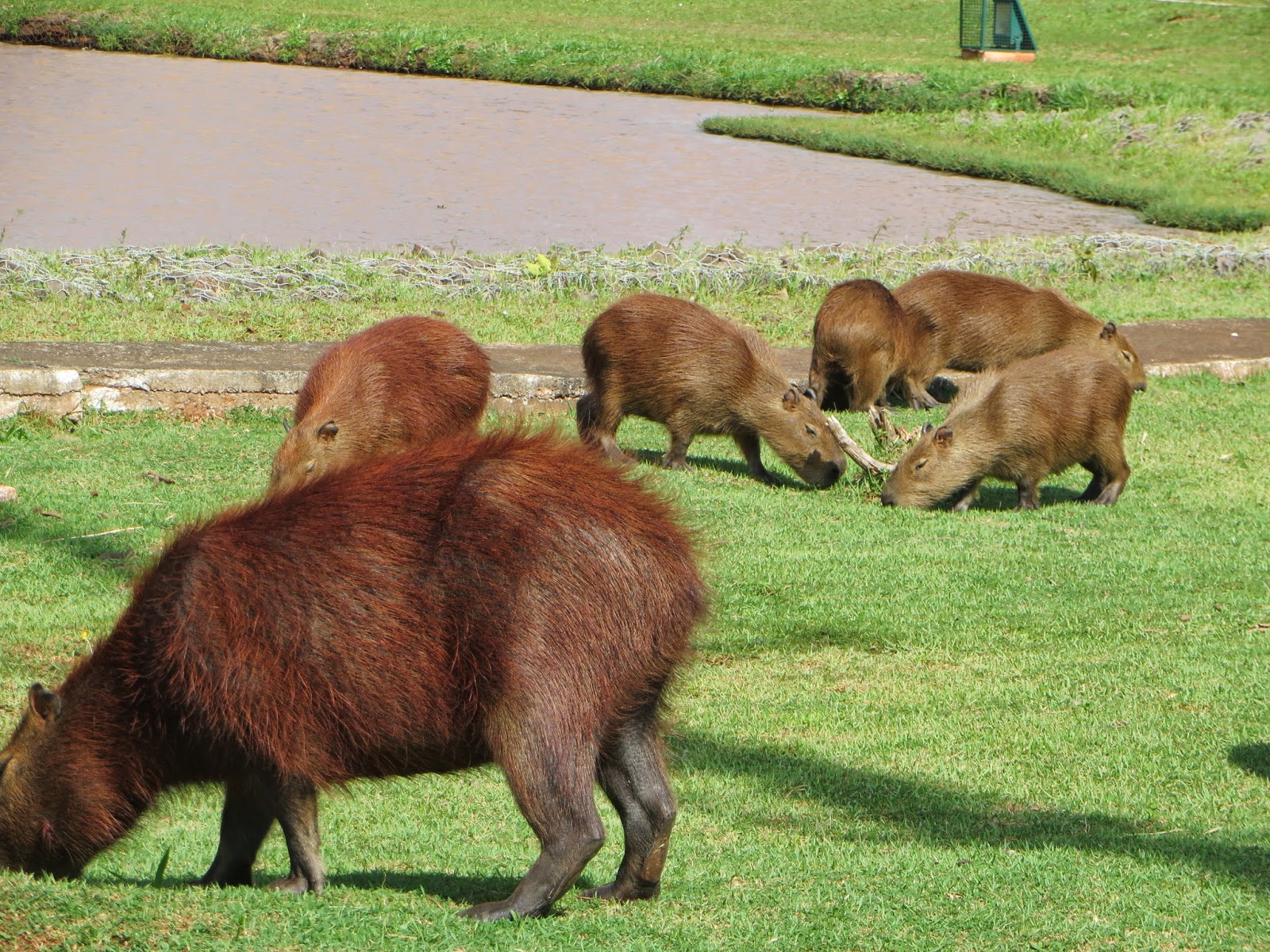
Campo Grande is usually passed through on the way to Bonito and The Pantanal with a pick up arranged at either the bus station or airport to avoid going into the town at all. Having had generally poor to zero response from Pantanal tours based in Cuiaba we were still trying to finalise a trip and stopped over in Campo Grande while we confirmed. At the airport we met Gil from Pantanal Discovery who was good with the patter and sales pitch but we thought the trips may be at the cheep end in delivery as well as price. We settled on a trip and made plans to head to Bonito for a couple of days first. Campo Grande turned out to be well worth a night. Vitoria Regia hostel was a good place to stop, despite a bigger than usual language barrier. A friendly hostel who can get mates rates on the Vanzella bus to Bonito, 15 reais off the normal price. The hostel is based overlooking Orla Morena a purpose built walkway used as a running, cycling and skating track the like of which you see all across South America. These are well used meeting places especially in the early evenings. Being busy they are safe and well lit. We were fortunate to be there on a Thursday, where we discovered a great market selling an array of food, clothes, mobile phones and the usual market goods. There was a small stage with some kind of stand up comedy which seemed to be poking fun at the colonial past, but I couldn't be certain. The food was a range of Brazillian from various regions and Japanese. Great fun to wander around and take in what was clearly a night out for locals as we were possibly the only gringos there. Passing back through Campo Grande after the Pantanal trip we spent the afternoon at the park watching the Capybara swimming in the lake and grazing on the banks at our feet. We actually saw more Capybara there than in the Pantanal but that's another story.
I always enjoy spending a bit of time in the less visited areas just enjoying less visited towns and getting a feel for an area without the pressure to tick sights off a list. Campo Grande is certainly worth a night, especially if you are passing through in time for the Thursday market on Orla Morena.

Sunday, 18 May 2014

Iguazu Falls, deservedly one of the 7 natural wonders of the world

Today I'm going to let the pictures do the talking. It is hard to find words to describe the falls, it is hard enough to agree on a spelling, Iguazu, Iguazzu, Iguasu and Iguassu all seem to be in regular usage. I always find a twinge of apprehension when approaching one of the great sites, the anticipation mixed with fear that this will be the one that doesn't live up to expectation. Today was not that day. I mean, just look at them.
Although clearly a picture doesn't do justice, it can't convey the impact on your other senses, the sound the smell, the feel of the spray. Iguazu falls are, quite simply worth the billing as one of the natural wonders of the world. We visited the Argentinian side on day one where there are various options of paths that take you to different views of the falls. We chose to attempt all the paths working from the furthest views and finishing at Garganta del Diablo, the devil's throat.
The lower path gives incredible distance views of the major falls, depending on water levels there are between 150 and 240 individual streams of water and this gives a sight of most of them. This path is also the entrance point to short boat rides to Isla San Martin which, after a reasonably strenuous climb gives much closer views and a takes you directly into the spray. We'd been at this spectacular viewpoint for a couple of minutes when another couple joined us, her open jawed wide beaming smile said everything, you could feel her awe. We stood there, giggling, it was all you could do. The whole of the lower path is the longest, about 1.6k and the climb up Isla San Martin is a bit tougher but if you are in relatively decent shape should be an absolute must. The views are breathtaking.
The upper path is flatter and busier with tour groups, though at the time we were there not overcrowded. The views are closer and looking down on the falls giving a very different perspective. Wildlife was closer with some incredible butterflies, birds and curious coates.
The last view point of the day, after a short train ride through the park, gets you up close and personal with Giganta del Diablo and boy do you look close. Walking towards the top of the falls the remarkable thing is how calm and slow moving the river is. Quietly meandering across the plateau you would have no idea what lies, one of the many similarities it shares with Victoria falls. Approaching the viewpoint the noise gradually takes over and you can almost feel the rumble. Feeling the spray in your face as you look down the horseshoe fall and down the valley across the park you feel all your senses become more alert. It is an experience you feel as much as you see.
We finished the day with a walk through the Macuco track where we saw more wildlife including our first monkeys of the trip. You really do need a full day. Day 2 Finally a Brasil stamp in the passport. At the third time entering the territory we final have the stamp to prove it. The Brasil side of the falls involve less walking but give access to a panoramic view of the whole area, including some streams you didn't have access to from Argentina.
Again the jaw dropping sight of approaching Garganta del Diablo leaves people grinning broadly and uncontrollably. While more compact and therefore more crowded, not as many people venture onto the walkway directly over a sheer drop where the spray soaks you to the skin. Light rain ponchos are available but again for me it is about feeling the experience as much as seeing it. If you go, the two sides give such different views you really should do both and on the Argentina side I would definitely do at least the lower loop and preferably Isla San Martin as well, you won't regret it. Having knocked off one of these great wonders that you have looked forward to seeing for so many years it can leave you feeling a bit flat, no longer having it to look forward to and the thrill of the anticipation. On this occasion I'm still buzzing off it.

Thursday, 15 May 2014

The dodgy immigration post - part 1

All the advice made it seem so simple. Get a bus to immigration, get your passport stamped, hop on another bus, get your passport stamped, leave Paraguay, go to Argentina. Job done. Land borders always have more potential for fun and games than airports, I always think they are far more fun too. Getting dropped off, we estimated, a kilometre from immigration was our first clue that we'd made the right call making an early start rather than fit in a mornings activity before crossing back to Argentina. As we walked through the busy market area of Ciudad del Este the queue of cars was our next hint.
We arrived at the Paraguayan immigration and were stamped out easily. Despite the lengthy queue of traffic we waltzed through immigration as there are agreements between certain Latin American countries that citizens don't need to perform immigration procedures, we appeared to be the only gringos crossing today. The Puente de la Amistad (Friendship Bridge) over the Iguazu river forms the border with Brasil and traffic funnels over it as shoppers return with their spoils. I have read that up to 80% of electronic equipment has been smuggled or otherwise sourced from Paraguay due to very different import restrictions. We'd been advised not to walk over the bridge due to robberies occurring, though it was hard to see how in daylight with so many people crossing, lots of locals were clearly walking. We scanned the line of waiting traffic as far as we could see and counted a grand total of no buses in line. As Dave Briggs, our original Dragoman driver from the Grand Asian Overland always said, now is the time for waiting. So, we waited. And waited. A couple of Argentinians joined us and seemed unconcerned, so we relaxed, and waited. A chirpy sock salesman explained that an Argentina bus was on it's way, a taxi driver suggested otherwise, we went with the sock salesman. A cuddly Peppa Pig salesman, trod on the the salesman's patch causing some lighthearted banter. For the record it was the Peppa Pigs that were cuddly, not the salesman. A bus appeared in the queue and made it's way towards us, after 20 minutes it became apparent - as predicted that it was a Foz (Brasil) bus and of no use to us. Repeat. A slightly higher quality vehicle appeared and the sock salesman gave us the nod that this was the Argentina bus and sure enough, it was, finally the right vehicle so we tipped the sock guy (he'd been friendly and helpful) and jumped on.
Interestingly, and surely the answer to a Trivial Pursuit question, the Argentinian border is 20k from Paraguay across Brasilian territory but as it is a non stop bus you do not clear Brasilian immigration. Crossing through Brasil but effectively in nopersons land was an interesting experience, having crossed over on the dam the previous day we had effectively been in Brasil twice but officially we hadn't yet made it. So near and so far but for now it was back to the Peso and huge anticipation for visiting the falls tomorrow

Environmental Impacts of Renewable Energy - thoughts from the Itaipu Dam

This post is going to be a bit deeper, there are things on my mind. In line with the way I'm writing this blog I'm putting in a disclaimer that these are thoughts tha have occurred to me, some questions I'm thinking through. It isn't meant to be taken as a thoroughly researched facual essay. Just thought I'd get that in there. I left Lake Ypycarai near Asuncion wondering if it was possible to travel for extended periods of time without returning home with a slightly Greener tinge to your politics. As detailed in a previous post Lake Ypycarai suffers from natural algal polution as well as man made polution through refuse and other avoidable measures. Set in stunning landscape it could be a natural wonder for people to enjoy and to provide work and income. It was a reminder of how good a job New Zealand does of protecting it's natural environment but also of how much work needs to be done to maintain it. I wondered how much bearaucracy and corruption you would have to break through to build a sustainable future for the lake. I wasn't to know my thoughts on green energy would be challenged so soon and in the same country. We visited the Itaipu dam on the Parana river, which forms the natural border between Paraguay and Brazil. The dam is still the largest Hydroelectric producing plant on earth, though in terms of dam size it has been knocked into second place by the Three Gorges dam in China. Renewable energy has always seemed like a great energy source, solar makes so much sense to me and the sheer power of water makes hydro a sensible way forward, using naturally occuring energy without destroying the source is good, yes?
The building of the Itaipu dam, commenced in 1973 resulted in the destruction of the Sete Quedus falls, the most spectacular waterfalls on earth with more than twice the volume flow of Niagara and twelve times that of Victoria falls and covering a greater area than the neighbouring Iguazu falls on the border of Argentina and Brazil only 20 killometres away. Not only were the falls drowned by the lake created for the dam, the Brazillian government, which had already dispanded Guaira Falls National Park to allow the project to go ahead, dynamited the rock face of the falls to remove the navigation hazzard eliminating any chance of restoring the site in future. One of the great wonders of the world gone for ever, surely an environmental catastrophe. In the process of creating the lake 10,000 families were displaced removing hundreds of years of history and splitting up families and communities, leading to the town of Foz do Iguazu growing from 32,000 to 136,000 people in ten years with no infrastructure to cope. In a final twist, as peole flocked in record numbers to catch a last glimpse of the falls before they were lost, a viewpoint collapsed killing 80 people. Generating an impressive 80% of Paraguay's energy and 20% of Brazil's is an engineering marvel, being the third most populous country just think how much sustainable energy has come fromthat one source. But there is no doubt it has come at huge environmental and social cost. It has merely posed in my mind the question of how far we go to generate renewable energy? How do we measure the cost / benefit of doing so? Would we allow the same to happen to Iguazu falls today? Yeah, they look nice but look at all that power!
The tour of the dam itself was impressive, it is truly an enormous project, employing at it's peak 40,000 people. The lake levels were at a level where the flood gates were closed as all the necessary water was going straight into the turbines which meant we missed the spectacular sight of the spillways in full flood. It did allow us to see the sheer size of them though which was awesome.
Interestingly as the dam straddles Paraguay and Brazil we crossed over into Brasilian territory, though without getting off the bus so immigration was unnecessary. The drive along the dam gave a close up view of the pibes surrounding the twenty turbines of which Brasil uses eighteen, effectively buying the electricity from eight of them from Paraguay. From the top of the dam there was a great view towards the twin cities of Foz do Iguazu in Brazil and Ciudad del Este in Paraguay, separated only by the river. An educational and interesting morning, I definitely recommend it.

Tuesday, 13 May 2014

The Jesuit Missions of Encarnacion

Our zig zag journey in a generally northerly direction had temporarily taken us further south. Encarnacion is known for being a smaller more laid back town and we were looking forward to experiencing a slightly different side of Paraguay. Kerana Hostel looked like a good choice, location wise being only a few minutes walk from the bus station is always a winner. Being directly opposite Habib's which is highly recommended for the local delicacy the Lomito Arabe. A twist on the Shwarma / kebab with less chili and a delicious heavy on the garlic mayonnaise, washed down with a cold Brahma we were all set. The main reason people visit Encarnacion is to see the UNESCO world heritage site of La Santisima Trinidad de Parana and Jesus de Tavarangue, Jesuit missions dating from 1609, and given world heritage status in 1993. They are apparently the least visited of all UNESCO sites. Given the lack of guide book information on how to get there this seems likely. There are no tours available (business opportunity : note to self) so it is back to good old local buses. At the bus station the touts soon sussed out the gringos and pointed us in the right direction, opting again for the 5,000 rather than 10,000 option we knew what we were getting by now! Once again pidgin Spanish conversation was struck up, and we were thrown off the bus in the right spot.
Starting at the mission itself we were offered the promo video which was perfectly timed to give a taste of the history and available in three languages. Wandering up to the missions themselves, the red each of the landscape had given the missions a stunning hue. Trinidad, the first mission we visited is the largest of the sites, containing houses for the missionaries, the local guarani people who were being introduced to the new religion as well as important buildings needed for a settlement of it's size. We were also able to see the stone walls laid out for garden and crop growing areas.
Dating from 1609 the Trinidad site was the earliest of the two we visited, along with two other tourists, amazing for a site with World heritage status. When we were ready to move to the next site of Jesus de Tavarangue, 12k away the ticket office called us a taxi as there was no other way of getting there. How many countries would the top tourist site either need or be able to offer that service? A few minutes later a dodgy looking tuk-tuk appeared at the end of the cobbled street, oh, please be our transport I exclaimed and wasn't to be disappointed. The three of us piled on for the 12k journey and what a way to see the countryside.
Arriving at Jesus we were this time the only visitors, the remaining buildings have been largely restored giving a real feel for how imposing these buildings would have been in the 1600's. This site on a hillside overlooking the surrounding area would have been a very powerful message of intent.
Paraguay, has continued to impress and delight, this was another day when the people couldn't do enough for us, and were great fun, the tuk-tuk driver even took our picture for his publicity shots. Again we looked forward to moving on, this time to Ciadad del Este to see the Itaipu dam, only recently beaten by the Three gorges dam in China as the largest in the world and still the largest hydro electric generator.

Sunday, 11 May 2014

The inevitable Dodgy bus post, part 1

Crazy bus journeys are the heartbeat of great travel. The local buses were full of chewing gum, sock and general food vendors hopping on and off as the bus travelled through Asuncion. One journey enlivened by a woman so round if the driver slammed his anchors on I'm sure she'd have rolled down the aisle, her missing teeth didn't help concentration as she shouted a sermon before starting kissing people while requesting a handout, what for will forever remain a mystery to me. The longer journeys had so far proven slightly less eventful but the entertainment level was about to be ramped up as we made a move towards Encarnacion. We left Le Jardin with Louise, who was heading in the same direction. Louise was on the last few days of a twelve month tour and Encarnacion would be her last stop before heading home to Dublin. Having established there were busses almost hourly, we thought, rock up at the bus station, no drama. Our company of choice had no seats until the following evening which caught us a back. We opted for the first bus that we could get on, with only an hour to wait and at a bargain price. On arrival it appeared the bus was more of a local service than the swish double decker number in the poster! Why are they never like in the poster? Oh well, for 50,000 guaranis you can't complain, though we already had doubts that the promised five hours looked realistic. Leaving on time was a good sign but as more and more people started getting on it became clear that it was a full on local service, I began wondering how people were still finding seats at the back, before it became clear, they weren't, it was again standing room only. Less than an hour into the journey and a Paraguayan lady who was lets just say more mature than I am stood right beside me. Having noticed that it didn't particularly seem to be the custom to give up your seat I qickly processed a) If you give up your seat you could be standing for seven hours b) It's all about equality, right? c) She's not that old d) None of the locals are doing it and of course I gave her my seat. I wearily got out my book and settled in for a long journey. Interestingly they seemed to have selected the fattest man in Paraguay to check tickets. Not the ideal man for squeezing up and down the aisle. He was dressed in full corporate uniform, though his shirt had seen better days with the odd here and there. This situation was improved immensely when the first Chipa salesman got on (Chipa is a delicious doughnut like corn bread with cheese, sometimes in rings sometimes stuffed with mince), goody for us he was the worlds fattest, albino Chipa salesman. So as more people got on the fat conductor and the fat albino Chipa man fought for aisle domination rights. The controller's shirt gradually becoming untucked, revealing more holes. As the two of them moved up and down the aisle they were joined by small boys selling apples and lottery ticket For the record, apples seemed to outsell lottery tickets, Chipa outsold everything and the now slightly dishevelled fat controller won the battle for aisle supremacy I just hoped for a seat. Over an hour into the journey we finally made it past the outskirts of Asuncion and it was clear we were staring down the barrel of a lot longer than the promised five hour journey. Fortunately, not all the passengers were on the full trip and the standing room started thining and the lady I'd given my seat to got off (a gracias wouldn't have hurt). A couple of fine Chipa kept me going and it was down to settling in, the flat, dry campo stretched out with only the odd small village and a couple of small towns in between. By the time we reached Encarnation around seven hours after leaving I felt for Louise as she was already suffering a lower back problem. A dodgy bus, sure but we were happy to be there and the journey overall had been good. The search for the bus on the poster continues.